Private jet Falcon Field basics
Falcon Field is Mesa's general aviation airport, with a 5,100-foot runway at 1,394 feet elevation. In July, density altitude reaches about 4,900 feet, which affects performance. This guide covers runways, the lone FBO, seasonal heat, and alternatives.
- KFFZ · MSCfield idents
- 1,394 ftfield elevation
- 5,100 ftlongest runway
- 10 mito Old Town Scottsdale
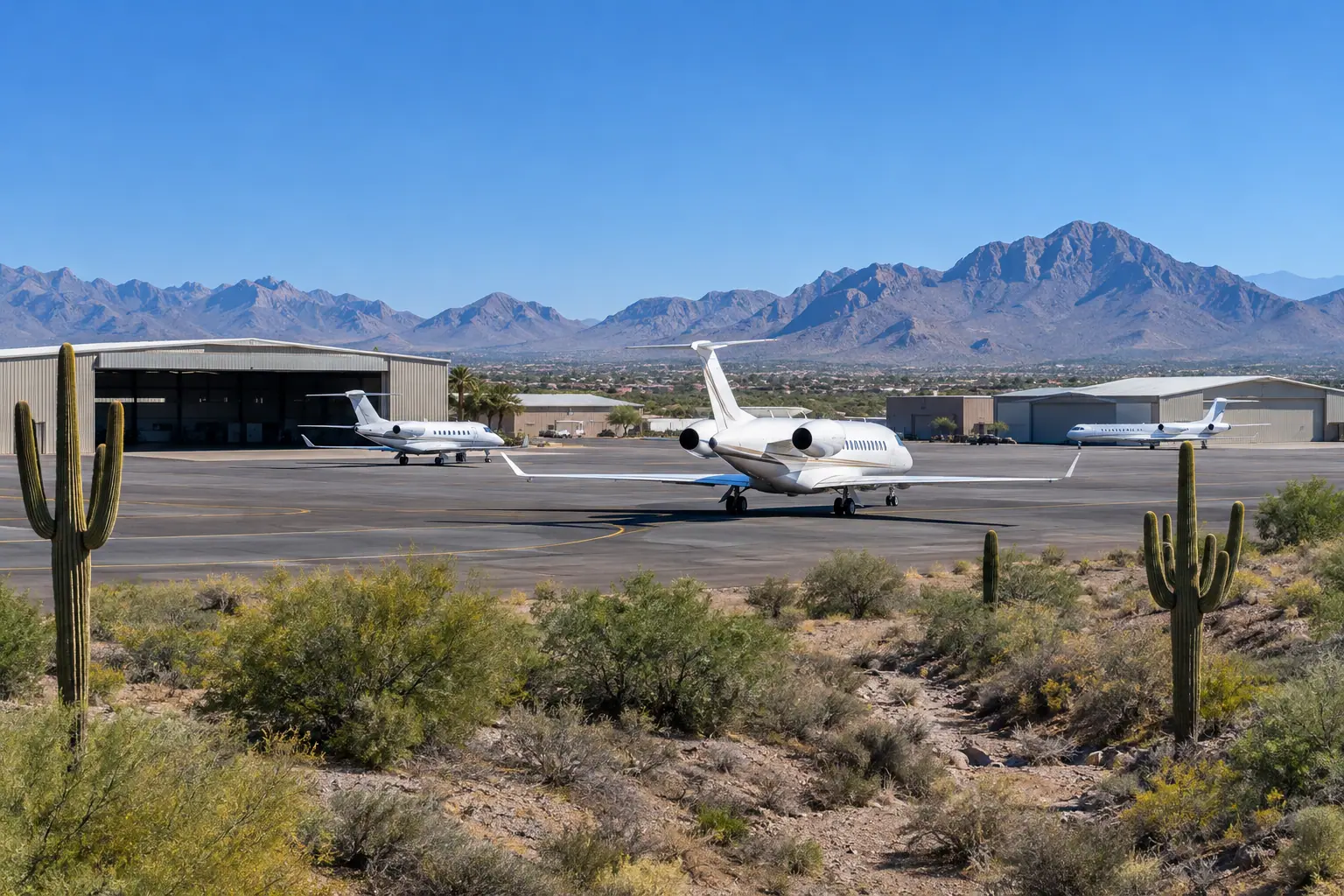
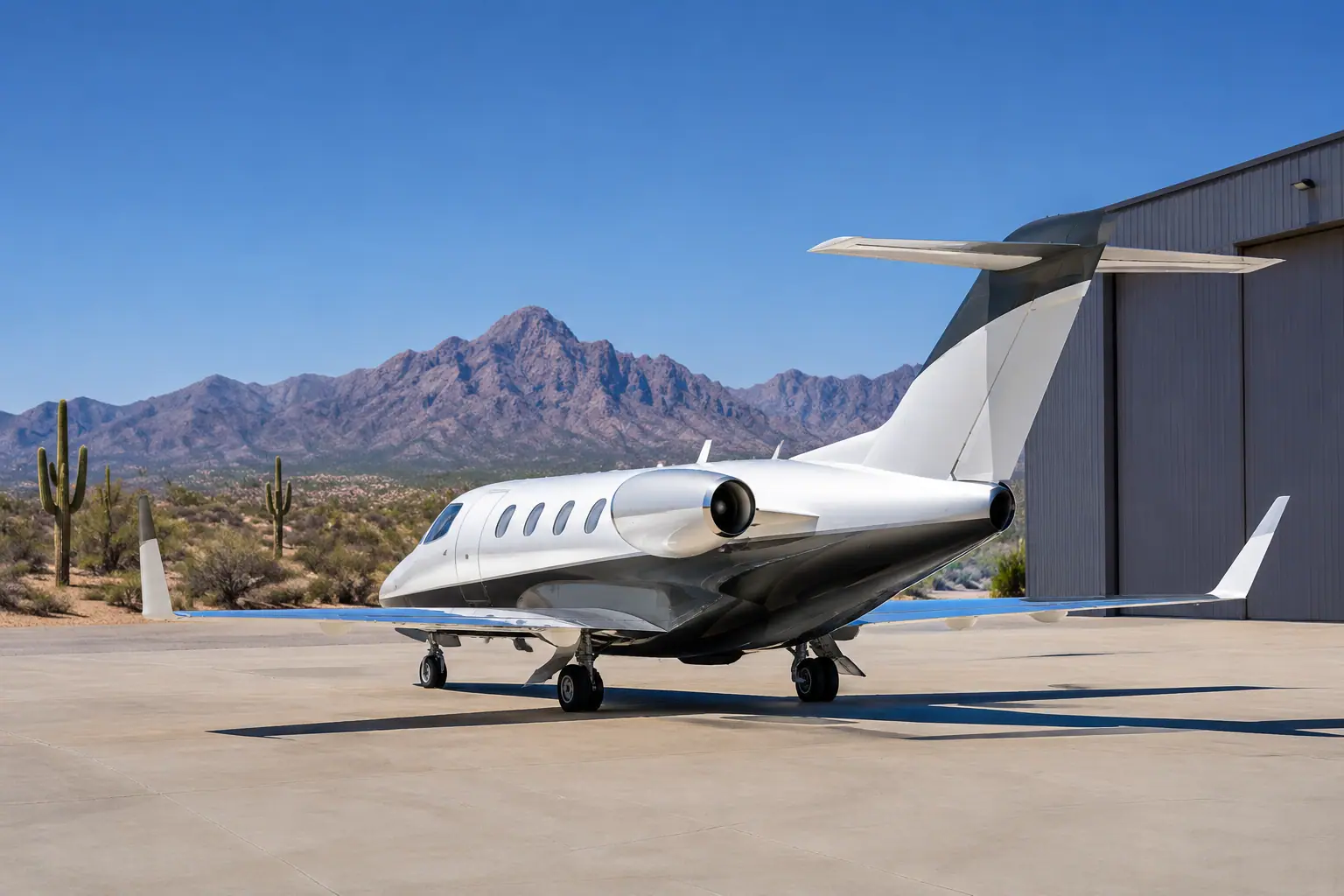
Falcon Field sits at 1,394 feet elevation with a single 5,100-foot runway that shapes which aircraft can depart on hot afternoons. The field is in east Mesa, roughly 268 miles from the Scottsdale strip by road, so it is not the closest airport to most Scottsdale addresses. It is, though, a practical option for travelers heading toward the East Valley or the Superstition Mountains corridor.
The airport has one FBO, Heliponents, Inc., which handles ground support and parking. For private jets, Falcon Field works best for light and midsize aircraft that can accept a shorter runway and higher density altitude. Larger cabin jets typically need more pavement or a lower field elevation, so your operator will compare numbers before committing to a route.
When you book a private jet Falcon Field arrival, the operator holds operational control and makes the final call on performance, weather, and fuel. As a broker, we arrange the flight and put you with a carrier that fits the mission. FAA Part 135 rules govern the flight, and DOT Part 295 covers how we act as your agent in the transaction. That distinction matters if a schedule changes or a leg needs to be rerouted.
Summer is the variable to watch. Falcon Field's high hit 106F in July, with density altitude near 4,900 feet. At 115F, density altitude can reach about 5,400 feet at Falcon Field, which is meaningful for takeoff distance and climb rate. Pilots plan around it with weight limits, early departures, or a different airport.
The field is not a full-service international gateway. There is no customs on site, so any leg crossing a border needs a stop at a port of entry with CBP. For domestic trips, Falcon Field is a low-friction option when your destination or origin is on the east side of the metro.
Runway and performance at Falcon Field
Falcon Field's longest runway is 5,100 feet, with field elevation at 1,394 feet, which is workable for many light and midsize jets but not all heavy or long-range types. Runway length alone does not tell the story in Arizona. On a 106F July afternoon, density altitude climbs to about 4,900 feet, and the same jet that leaves comfortably at dawn may need a weight restriction later in the day. If your aircraft is a large-cabin model, then the operator will usually compare Falcon Field against Mesa Gateway or Scottsdale before accepting the trip. When a leg is long or the passenger load is heavy, so a longer runway often makes more sense. Your pilot computes takeoff and landing distances for the actual temperature, wind, and weight, and that calculation, not the brochure range, decides whether the flight goes.
| Runway | Len. | Wid. | Surface |
|---|---|---|---|
| 04R/22L | 5,100 ft | 100 ft | Asphalt |
| 04L/22R | 3,799 ft | 75 ft | Asphalt |
FBO and ground services at Falcon Field
Falcon Field has one FBO, Heliponents, Inc., which supports parking and ground handling for based and transient aircraft. That is a smaller footprint than you will find at Phoenix Sky Harbor or Scottsdale, where several FBOs compete for business. The trade-off is straightforward: fewer choices on the ground, but less congestion and a simpler arrival for light and midsize jets. If your itinerary needs a specific catering order, a large ground crew, or a quick international departure, then confirm those details well before the flight. When multiple aircraft are arriving together, so the operator will coordinate parking ahead of time with the FBO. For most domestic trips with a small party, the single-FBO setup is not a problem.
When Falcon Field makes sense
- Travelers whose trip starts or ends in east Mesa, Apache Junction, or the Superstition corridor, where the drive is shorter than to Scottsdale Airport.
- Light and midsize jet charters on domestic routes where 5,100 feet of runway and a single FBO are enough.
- Groups flying to or from Phoenix Mesa Gateway area events who want a lower-traffic alternative on the east side.
- Early-morning summer departures, when density altitude is closer to the January figure than the July afternoon peak.
| Class | Typical runway need | Here |
|---|---|---|
| Turboprop | 3,300 ft+ | Fits |
| Light jet | 4,000 ft+ | Fits |
| Midsize jet | 5,000 ft+ | Fits |
| Super-midsize jet | 5,200 ft+ | Weight-limited |
| Heavy jet | 5,600 ft+ | Weight-limited |
Density altitude and summer heat
Density altitude at Falcon Field runs from about 2,100 feet in January to 4,900 feet in July, and that swing is the single biggest planning factor at this airport. Spring and fall are forgiving. April sits near 3,500 feet and October near 3,700 feet, with high temperatures in the mid 80s to upper 80s. Summer changes the math. June, July, and August bring highs of 104F to 106F and density altitudes around 4,700 to 4,900 feet, and the peak case at 115F reaches about 5,400 feet. If you are flying a turbojet with plenty of margin, then the heat mostly affects departure timing. When the aircraft is a light jet near its weight limit, so an early morning departure or a longer runway at Mesa Gateway or Phoenix Sky Harbor is often the better call. Wet days are few, but July has about five of them, and convective weather in monsoon season can reroute a flight with little notice. FAA Part 135 operators build those contingencies into the schedule.
| Month | Avg high | Wet days | Density altitude |
|---|---|---|---|
| Jan | 65°F | 5 | 2,100 ft |
| Feb | 70°F | 4 | 2,500 ft |
| Mar | 76°F | 4 | 2,900 ft |
| Apr | 86°F | 1 | 3,500 ft |
| May | 93°F | 1 | 4,000 ft |
| Jun | 104°F | 1 | 4,700 ft |
| Jul | 106°F | 5 | 4,900 ft |
| Aug | 104°F | 4 | 4,700 ft |
| Sep | 99°F | 3 | 4,400 ft |
| Oct | 89°F | 2 | 3,700 ft |
| Nov | 76°F | 2 | 2,900 ft |
| Dec | 66°F | 4 | 2,200 ft |
Getting to and from Falcon Field
Falcon Field is about 268 miles from the Scottsdale strip by road, in east Mesa, so the drive depends heavily on where you start. From most Scottsdale addresses, Scottsdale Airport is closer and has five FBOs, while Falcon Field serves the east valley. If your destination is Apache Junction, Gold Canyon, or the Superstition Mountains, then Falcon Field usually cuts the ground time. When you are staying in central Scottsdale or Paradise Valley, so the shorter runway field may not be worth the extra drive unless your aircraft type requires it. The airport sits near the US 60 and Loop 202 corridor, which keeps car access simple outside rush hour. Your operator or FBO can arrange ground transport, and for international legs, plan a stop at a CBP port of entry because Falcon Field does not clear customs.
Routes routed through Falcon
These 6 private jet routes span 345 to 1,842 nautical miles, with one-way light jet quotes from $4,500 to $32,000.
This airport, answered
Can a private jet Falcon Field flight use the airport in summer?
Yes, with performance limits. Falcon Field's runway is 5,100 feet at 1,394 feet elevation, and July density altitude reaches about 4,900 feet. At 115F it can hit roughly 5,400 feet. Light and midsize jets often operate with weight restrictions or early departures, while heavier aircraft may move to Mesa Gateway or Phoenix Sky Harbor. The FAA Part 135 operator makes the final call based on temperature, wind, and load.
What FBO serves private jets at Falcon Field?
There is one FBO, Heliponents, Inc., which handles parking and ground support. That is a smaller operation than the five FBOs at Scottsdale Airport or the two at Phoenix Sky Harbor, so larger parties or complex catering should be coordinated in advance. For most light and midsize jet flights with a small group, the single-FBO setup works fine.
How far is Falcon Field from Scottsdale?
About 268 miles by road from the Scottsdale strip, which puts it in east Mesa rather than near Scottsdale itself. Scottsdale Airport is closer for most Scottsdale addresses. Falcon Field is the better choice when your trip begins or ends in Apache Junction, Gold Canyon, or the east valley, where the drive is shorter and traffic is lighter.
What runway length does Falcon Field have for jet charters?
The longest runway is 5,100 feet, with field elevation at 1,394 feet. That length suits many light and midsize jets, but not all large-cabin aircraft, especially on hot afternoons when density altitude is high. If your aircraft needs more pavement, then Mesa Gateway's 10,401-foot runway or Phoenix Sky Harbor's 11,489-foot runway are the usual alternatives in the metro.
Does Falcon Field have customs for international flights?
No. Falcon Field does not have on-site customs, so any international leg needs a stop at a CBP port of entry before or after the domestic segment. Your operator and broker plan that stop into the route. For domestic flights within Arizona and the lower 48, no customs clearance is involved, and TSA screening is not part of a typical private charter departure.
Who operates the jet when I book through a broker?
The flight is flown by an FAA Part 135 operator that holds operational control, including the final say on routing, weather, and performance. We act as your agent under DOT Part 295, arranging the charter and matching you with a carrier. Prices you see are estimates until the operator confirms aircraft availability and the route. That structure is standard for charter brokers and worth understanding before you book.